

You complete a course of antibiotics, your urinary symptoms improve and life returns to normal. Then, weeks or months later, the burning, urgency or frequent urination comes back.
When urinary tract infections (UTIs) keep returning, repeatedly treating each episode may not be enough. Some women have identifiable triggers, while others may have hormonal changes, bladder-emptying problems, urinary stones or another condition contributing to the recurrence.
It is also important to confirm whether each episode is genuinely caused by a bacterial infection. Several bladder, pelvic and vaginal conditions can produce symptoms similar to a UTI but require different treatment.
A urological assessment can help identify patterns, confirm the diagnosis and determine whether an underlying problem needs to be addressed.
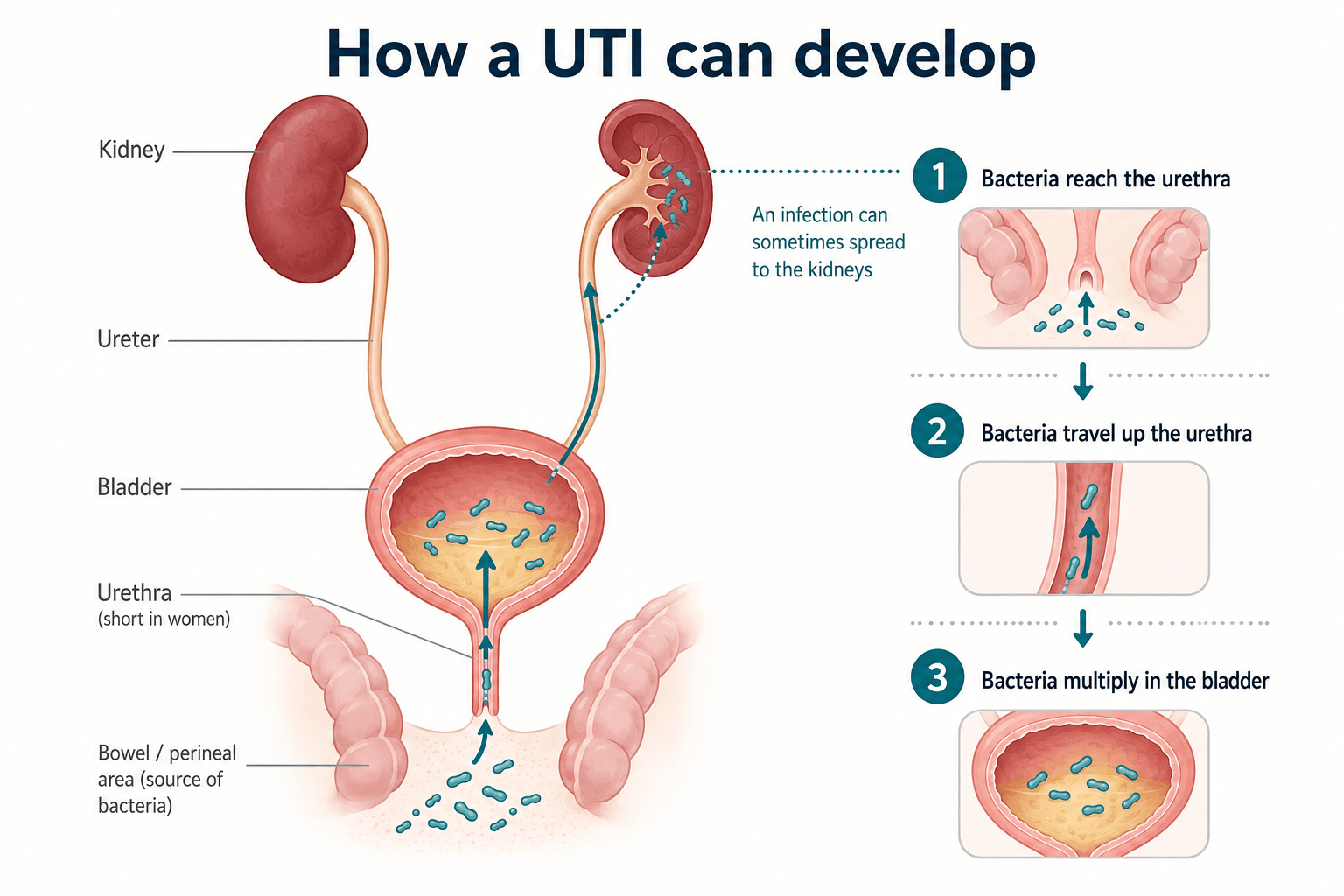
What counts as a recurrent UTI?
A recurrent UTI is generally defined as:
- At least two UTIs within six months; or
- At least three UTIs within 12 months.
Typical symptoms include pain or burning during urination, needing to urinate more frequently, a sudden urge to urinate and lower abdominal discomfort.
However, symptoms alone do not always confirm that a UTI is present. Where possible, urine testing and cultures can help show whether bacteria are responsible, particularly when infections appear to keep returning.
Recurrent UTIs may involve:
- Reinfection — a new infection occurring after the previous one has cleared, which may be caused by the same or a different type of bacteria.
- Relapse — the original infection returns shortly after treatment, sometimes because the bacteria were not fully cleared or because there is a persistent source of infection.
This distinction may help guide whether further investigation is needed. Current urological guidance emphasises documenting evidence of urinary inflammation and bacteria alongside symptoms when diagnosing recurrent bacterial UTIs.
Why do UTIs keep coming back?
There is not always one clear cause. In some women, several factors may contribute at the same time.
| Factor | How it may contribute |
| Sexual activity | Sexual intercourse can move bacteria towards the urethra. If infections consistently occur after intercourse, this pattern may help guide prevention. |
| Spermicide use | Spermicides can affect the protective bacteria around the vagina and may increase the likelihood of UTIs in some women. |
| Menopause | Lower oestrogen levels can change the tissues and bacterial environment around the vagina and urethra, making some women more susceptible to infection. |
| Incomplete bladder emptying | Urine remaining in the bladder gives bacteria more opportunity to multiply. This may occur because of bladder dysfunction, pelvic organ prolapse, neurological conditions or urinary obstruction. |
| Kidney or bladder stones | Stones may obstruct urine flow or provide a surface on which bacteria can persist. |
| Urinary tract abnormalities | Structural or functional problems affecting the kidneys, ureters, bladder or urethra may make infections more likely or more difficult to clear. |
| Diabetes or reduced immunity | Poorly controlled diabetes and conditions or medications that affect the immune system may increase susceptibility to infection. |
Could recurrent symptoms be something other than a UTI?
Yes. Burning, urgency and frequent urination can occur even when a urine culture does not show a bacterial infection.
Possible explanations include:
- Overactive bladder — can cause urgency, frequent urination and urinary leakage.
- Bladder pain syndrome or interstitial cystitis — may cause bladder pressure, pelvic pain and frequent urination without a bacterial infection.
- Pelvic floor dysfunction — tight or poorly coordinated pelvic floor muscles can cause urinary discomfort and difficulty emptying the bladder.
- Genitourinary syndrome of menopause — declining oestrogen levels can cause vaginal dryness, irritation, burning and urinary symptoms.
- Vaginal infections or irritation — conditions affecting the vaginal or vulval tissues may be mistaken for urinary infections.
- Urethritis or sexually transmitted infections — inflammation of the urethra may cause burning during urination.
- Urinary stones — bladder or kidney stones can cause pain, urinary urgency and blood in the urine.
- Other bladder or urinary tract conditions — particularly when symptoms are persistent, unusual or accompanied by blood in the urine.
If symptoms repeatedly occur but urine cultures are negative, continuing to take antibiotics may not address the actual cause. Further assessment can help distinguish an infection from another urinary or pelvic condition.
When should you see a urologist?
A single uncomplicated UTI that improves with treatment can often be managed by a GP. You may benefit from seeing a urologist if:
- You have at least two UTIs within six months or three within a year.
- Your symptoms keep returning after antibiotics.
- Urine cultures repeatedly confirm bacterial infections.
- Your symptoms persist despite treatment.
- You repeatedly have UTI-like symptoms but urine cultures are negative.
- You have blood in your urine.
- You experience recurrent pain in your back, side or lower abdomen.
- You have difficulty starting urination or emptying your bladder.
- You have a history of kidney or bladder stones.
- Your infections began or became more frequent after menopause.
- The same type of bacteria repeatedly appears on urine cultures.
- You have diabetes, a weakened immune system or another condition that may increase infection risk.
Men, children, pregnant women and people with catheters or known urinary tract abnormalities may require a different approach and should discuss recurrent infections with a doctor.
What are the treatment and prevention options for recurrent UTIs?
Treatment depends on whether there is an active bacterial infection, how frequently infections occur and whether an underlying cause has been identified.
Treating the current infection
When a bacterial UTI is diagnosed, an appropriate antibiotic may be prescribed. The choice of antibiotic can depend on:
- The bacteria identified on urine culture.
- Antibiotic sensitivity results.
- Previous infections and treatments.
- Medication allergies.
- Kidney function and other medical conditions.
- Local patterns of antibiotic resistance.
Antibiotics treat the current infection but may not prevent another one from developing. Frequent or unnecessary antibiotic use can also cause side effects and contribute to antibiotic resistance. This is why confirming the diagnosis becomes particularly important when symptoms repeatedly return.
Addressing an underlying cause
When another urinary problem contributes to the infections, treatment may involve:
- Improving bladder emptying.
- Managing pelvic organ prolapse or pelvic floor dysfunction.
- Treating kidney or bladder stones.
- Addressing urinary obstruction or structural abnormalities.
- Improving the management of diabetes.
- Reviewing catheter care where applicable.
- Treating vaginal or menopausal tissue changes.
Addressing the contributing problem may help reduce the likelihood of further infections.
Vaginal oestrogen
Vaginal oestrogen may be considered for suitable peri- and postmenopausal women. It can help address tissue and bacterial changes associated with lower oestrogen levels and reduce the likelihood of recurrent UTIs.
Vaginal oestrogen is different from systemic hormone replacement therapy.
Preventive antibiotics
For women with frequent, confirmed infections, antibiotic prophylaxis may sometimes be considered. Depending on the infection pattern, this may involve:
- A single antibiotic dose around an identifiable trigger, such as sexual intercourse.
- A low-dose antibiotic taken regularly for a defined period.
- A patient-initiated treatment plan for selected women who can reliably recognise their symptoms.
The benefits should be weighed against possible side effects and antibiotic resistance.
Methenamine hippurate
Methenamine hippurate is a non-antibiotic urinary antiseptic used to prevent UTIs rather than treat an active infection. It may be considered as an alternative to daily antibiotic prophylaxis for suitable women whose current UTI has already been treated.
It is not appropriate for everyone and can interact with products that make the urine more alkaline. Its use should therefore be discussed with and monitored by a doctor.
Intravesical treatment
Selected patients may be offered intravesical treatment, in which a therapeutic solution is placed directly into the bladder through a catheter. These treatments are intended to support the bladder lining and may be considered when conventional preventive measures have not provided sufficient relief.
UTI vaccine (Uromune)
Uromune is a sublingual immunostimulant that may be considered for selected patients with recurrent UTIs. It contains inactivated forms of four bacteria commonly associated with urinary infections and is administered as a daily spray under the tongue over three months.
Uromune is intended to help reduce the recurrence of UTIs rather than treat an active infection. A urologist will first need to confirm that the recurring symptoms are caused by bacterial infections and assess whether another urinary condition is contributing.
When should you seek urgent medical attention?
Seek prompt medical attention if urinary symptoms are accompanied by:
- Fever or chills.
- Pain in the back or side, particularly below the ribs.
- Nausea or vomiting.
- Feeling severely unwell, weak or faint.
- Confusion, unusual drowsiness or difficulty speaking.
- Difficulty passing urine or being unable to urinate.
- Heavy bleeding or blood clots in the urine.
- Rapidly worsening symptoms.
- Symptoms that worsen or do not begin improving within 48 hours of starting treatment.
- Pregnancy or possible pregnancy.
These symptoms may indicate that an infection has reached the kidneys, that the urinary tract is obstructed or that a more serious infection is developing. Kidney infections can become serious without timely treatment.
Recurrent UTI Assessment in Singapore
UTIs can recur for several reasons. Some may be linked to sexual activity or hormonal changes, while others may involve incomplete bladder emptying, urinary stones or another underlying urinary condition. In some cases, recurring symptoms may not be caused by a bacterial infection at all.
Preventing further episodes therefore begins with understanding why they keep occurring. A urologist can review your symptoms and infection history, confirm whether bacteria are present and assess for factors that may be contributing to the recurrence. This helps determine whether you need treatment for an active infection, preventive therapy or management of an underlying condition.
At AARE Urocare, Dr Fiona Wu provides assessment and treatment for recurrent UTIs and other bladder and urinary conditions. If your UTIs keep returning or your urinary symptoms have not improved as expected, schedule a consultation for an individual assessment and discussion of your treatment options.
Frequently asked questions
Can sexual intercourse cause recurrent UTIs?
Sexual activity can move bacteria towards the urethra and may trigger UTIs in some women. If infections consistently occur after intercourse, your doctor may recommend targeted preventive measures.
Can menopause increase the risk of recurrent UTIs?
Yes. Lower oestrogen levels can change the tissues and bacterial environment around the vagina and urethra. Vaginal oestrogen may be considered for suitable peri- and postmenopausal women.
Do recurrent UTIs always require a cystoscopy?
No. Cystoscopy is generally reserved for selected cases, such as persistent blood in the urine, unusual symptoms or suspected bladder abnormalities.
Can cranberry supplements or D-mannose prevent recurrent UTIs?
Cranberry may help some women, although products and doses vary. Evidence for D-mannose remains inconsistent. Speak with your doctor before relying on supplements as an alternative to established preventive treatment.